
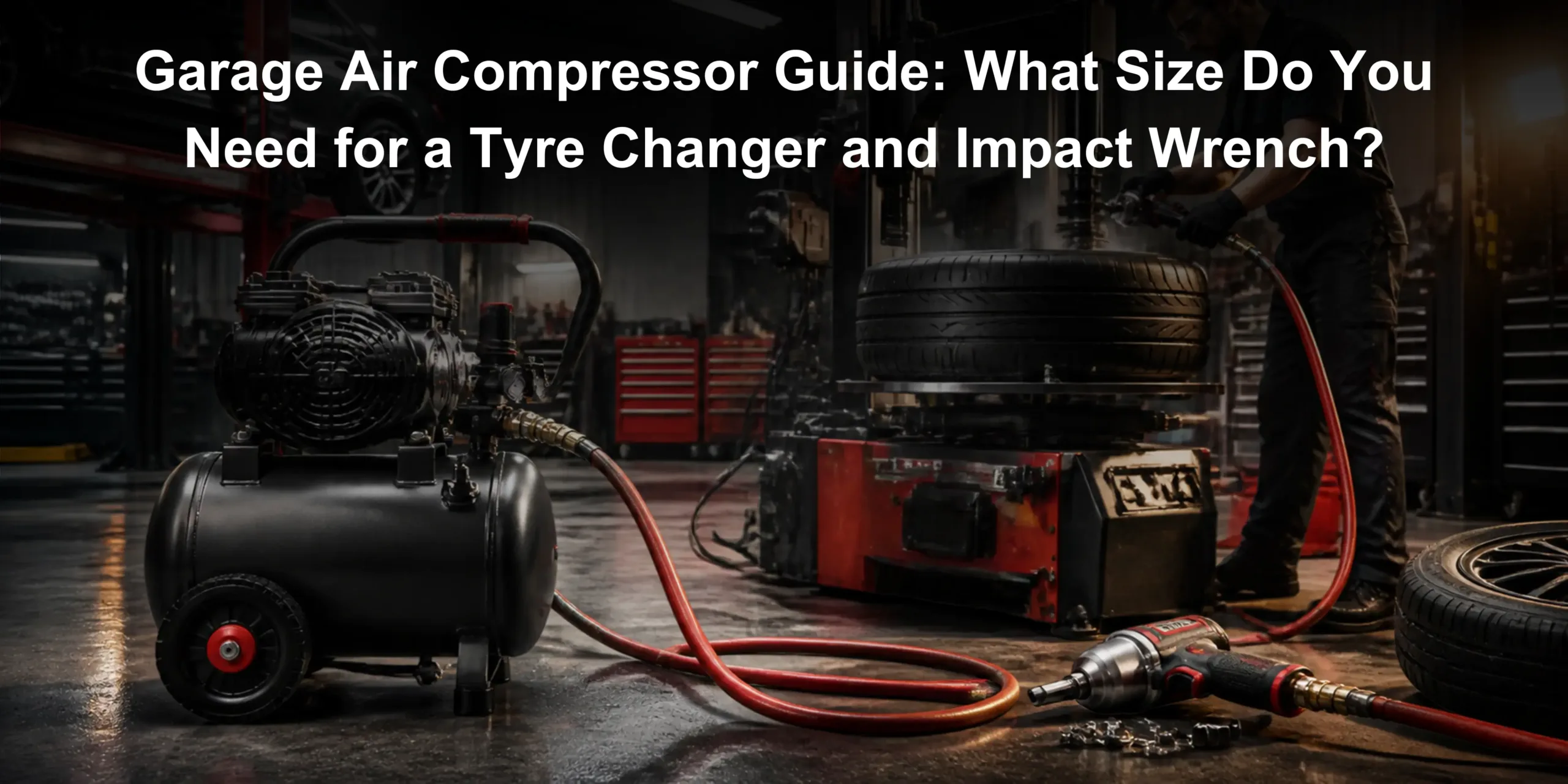
Garage Air Compressor Guide: What Size Do You Need for a Tyre Changer and Impact Wrench?
You bought a good tyre changer, plugged in a compressor that looked big enough, and now the bead breaker feels weak, the compressor runs non-stop and the impact wrench slows down halfway through a wheel. Sound familiar?
Most of these problems come from one mistake: choosing a garage air compressor by horsepower or tank size instead of by the air your machines actually use. This guide shows you how to size a compressor properly, using a tyre changer and an impact wrench as the working example, so you buy once and get it right.
Quick answer: Size a garage air compressor by air flow (CFM or litres per minute) and pressure, not by horsepower or tank size. Add up the air your machines use at the same time, add about 25 to 30 percent headroom, and check that the compressor can reach the pressure your tyre changer needs. Always confirm the exact figures in your machine’s manual.
Why horsepower and tank size mislead you
- Air delivery (CFM, L/min or m³/h): How much air the compressor really delivers, at a stated pressure.
- Pressure (bar or psi): The pressure it can reach and hold.
- Duty cycle: How long it can run before it needs a rest.
Quick unit converter
Unit | Equals |
|---|---|
1 bar | about 14.5 psi |
8 bar | about 116 psi |
10 bar | about 145 psi |
90 psi | about 6.2 bar |
1 CFM | about 28.3 L/min or 1.7 m³/h |
10 CFM | about 283 L/min or 17 m³/h |
Also remember that CFM is always quoted at a pressure, for example “CFM at 90 psi”. Compare compressors at the same pressure, or the numbers mean nothing.
What does a tyre changer need from a compressor?
A pneumatic tyre changer uses air for the bead breaker, the turntable and the clamps. Two things matter: pressure and flow.
Pressure. Check the operating pressure in the manual. For example, our TC-940 tyre changer is rated for 0.8 to 1 MPa, which is 8 to 10 bar, or roughly 116 to 145 psi. That detail matters, because many small single-stage compressors top out around 8 to 9 bar. If your compressor cannot reliably reach and hold the pressure your changer needs, the bead breaker will feel weak. Two-stage compressors reach higher pressure and are a safer match for machines near the 10 bar end.
Flow. The bead breaker is the biggest air user, and it works in short bursts. Published guides disagree on how much a tyre changer needs, with figures for car machines ranging from about 4 to 10 CFM, and some heavy-duty units listing 15 to 25 CFM. The spread is real, because machine size and design differ. The only number you can trust is the one in your own machine’s manual or datasheet.
Hydraulic changers are different. A heavy-duty hydraulic machine such as the TTC-800 commercial vehicle tyre changer runs on a hydraulic pump motor, so it does not rely on compressed air to operate. You will still need air to inflate large tyres, and for any impact wrench or air tools in the bay.
For the TITR-1224, which has a strong pneumatic bead breaker, check the operating pressure and air consumption in its manual before you pick a compressor. See all our tyre changers.
What does an impact wrench need?
An air impact wrench is a hungry tool because it runs continuously while you loosen or tighten nuts. Typical air use at 90 psi depends on the drive size:
Tool | Typical air use at 90 psi |
|---|---|
1/2 inch impact wrench | about 4 to 5 CFM |
3/4 inch impact wrench | usually between the two, check the datasheet |
1 inch impact wrench | about 10 CFM |
The exact figure depends on the tool. Check the datasheet of your air impact wrench for its CFM at 90 psi. A compressor that cannot keep up will make the wrench slow, weak and inconsistent.
How to size a garage air compressor in 7 steps
- List your air users. Tyre changer, impact wrenches, tyre inflation, air tools, spray guns.
- Find the CFM of each at its working pressure, from the manual or datasheet.
- Decide what runs at the same time. One technician with one wrench is very different from three bays working together.
- Add them up. For example, a tyre changer at 4 CFM, an air tool at 4 CFM and tyre inflation at 2 CFM total 10 CFM.
- Add headroom of about 25 to 30 percent. This is a rule of thumb that covers leaks, wear and future growth.
- Check the pressure. The compressor must comfortably reach the highest pressure any machine needs.
- Convert the units and compare compressors at the same pressure.
Worked examples
These use example figures. Replace them with the numbers from your own manuals.
Workshop | What runs together | Total | With 30% headroom |
|---|---|---|---|
Single-bay tyre shop | Tyre changer 8 CFM + impact wrench 5 CFM + inflation 2 CFM | 15 CFM | about 19.5 CFM (about 550 L/min) |
Two-bay service workshop | Tyre changer 8 CFM + two impact wrenches at 5 CFM each | 18 CFM | about 23.5 CFM (about 660 L/min) |
Commercial vehicle garage | 1 inch impact wrench at about 10 CFM + truck tyre inflation | Ask your supplier to size it | Rotary screw is often a better fit |
If your bay will be busy all day, the next section matters more than the numbers.
Piston or rotary screw? Single-stage or two-stage?
Type | Best for | Watch out for |
|---|---|---|
Single-stage piston | Small workshops with intermittent use | Lower maximum pressure (around 8 to 9 bar), so check against your tyre changer |
Two-stage piston | Garages that need higher pressure and steady use | Costs more up front, and still needs rest periods |
Rotary screw | Busy multi-bay workshops and continuous use | Higher purchase price, but built for long running hours |
Oil-free | Where clean air matters (for example painting) | Usually noisier and shorter-lived than oil-lubricated pumps |
As a rule, if your compressor would run more than about half the time, step up to a bigger piston unit or a rotary screw. A compressor that runs flat out all day wears out fast.
Does tank size matter?
A little, but less than most people think. The tank is a buffer. It smooths out the short bursts of a bead breaker and reduces how often the motor starts. It cannot make up for a pump that delivers too little air. Many workshops use a receiver of roughly 100 to 300 litres, matched to the pump output. A larger tank helps when you have sudden demand, but pump delivery is what limits you.
Check your power supply
Smaller compressors generally run on single-phase supply, while larger ones usually need three-phase. Ask an electrician to confirm your supply, the breaker rating, the cable size and the earthing before you order. A compressor that trips the breaker every time it starts is a very common problem.
Piping, hoses and installation
A good compressor can still perform badly through poor piping.
- Hose size: Use a hose with a large enough inner diameter, and keep runs short. A thin, long hose causes a big pressure drop at the machine.
- Fixed piping: For longer runs, use a proper main line, not a long coiled hose.
- Filter, regulator, lubricator: Fit one near the machine, as our tyre changers do, to remove moisture and set the right pressure.
- Drain point: Fit a drain valve at the lowest point.
- Location: Put the compressor in a cool, dry, ventilated spot away from dust and the bays, since the noise and heat add up.
- Quick couplers: Choose fittings rated for the flow your tools need. A small coupler can choke a big tool.
- Leaks: Even small leaks waste air and money, so listen for them at the end of the day.
Troubleshooting: when the compressor and the machine do not agree
Symptom | Likely cause | What to check |
|---|---|---|
Weak bead breaker | Pressure too low or too much pressure drop | Gauge at the machine, regulator setting, compressor maximum pressure, hose size |
Compressor runs non-stop | Demand is higher than output, or there are leaks | Total CFM against compressor output, leak check |
Impact wrench slows down | Not enough air flow | Wrench CFM, hose diameter, coupler size |
Water in the air line | Moisture in the tank and pipes | Drain daily, check the filter, install a drain point |
Breaker trips on start-up | Supply or cable too small | Electrician check of breaker, cable and phase |
Compressor overheats | Poor ventilation or too much running | Location, airflow, duty cycle |
Keep it running: a simple maintenance routine
- Every day: Drain the tank and check for oil or water leaks.
- Every week: Check the oil level and clean the intake filter.
- Every month: Check belts, fittings, the safety valve and the filter-regulator.
- Every year: Have a technician service it and inspect the tank, in line with the manufacturer’s guidance and local rules.
A compressor tank is a pressure vessel, so never modify it, never block the safety valve and have any damaged tank replaced.
Common mistakes when buying a garage air compressor
need compressed air? It does not use air to operate, but you still need air for inflation and for air tools.
Can you recommend a compressor for my bay? Yes. Tell us which machines you run and how many bays you have, and our team will help you plan the air supply. Call +91 9313135555 or send an enquiry through our contact page.
Get the air supply right the first time
The right garage air compressor is the one that matches your machines’ air flow and pressure, runs on your power supply and is installed with good piping and drainage. Size it from real numbers, leave headroom, and your tyre changer and impact wrench will work the way they should.
Ready to plan your bay? See our full product range, visit Technomatic Industries, or call +91 9313135555 for dealer and bulk pricing.
- Buying by horsepower or tank size. Compare CFM at a stated pressure instead.
- Ignoring the pressure. A compressor that cannot reach your machine’s operating pressure will never run it well.
- Sizing for one tool. Size for everything that may run at once.
- Zero headroom. Add 25 to 30 percent, or the compressor will be running flat out from day one.
- Skipping the filter and drain. Moisture ruins cylinders, valves and tools.
- Not checking the power supply. A great compressor on a weak supply is a headache.
Why choose Technomatic for your workshop air supply
Technomatic Industries has served Indian workshops since 2003. We are an ISO 9001:2015 certified garage equipment manufacturer based in Faridabad, and we supply the machines that use your compressed air, from tyre changers and impact wrenches to lifts and alignment equipment.
- One supplier for the whole bay: Tell us which machines are in your bay, and we will help you plan a matching air supply.
- Written specs before you order: Ask for each machine’s pressure and air consumption, and size your compressor from real figures.
- Manufacturer-direct pricing for dealers, distributors and workshops.
Browse our air compressor range, or read more about us.
Frequently asked questions
What size air compressor do I need for a garage? It depends on what runs at the same time. Add up the CFM of your tyre changer, impact wrenches, tyre inflation and air tools, then add about 25 to 30 percent headroom and check the pressure your machines need.
What size air compressor do I need for a tyre changer? Follow the manual. Published figures for car tyre changers range from about 4 to 10 CFM, and some heavy-duty machines need more. Check the required pressure as well, for example 8 to 10 bar for the TC-940.
What size air compressor do I need for an impact wrench? A 1/2 inch wrench typically uses about 4 to 5 CFM at 90 psi, and a 1 inch wrench about 10 CFM. Check your tool’s datasheet.
Is a bigger tank better? Not by itself. A bigger tank smooths short bursts, but the pump’s air delivery decides how well your machines run.
Do I need a two-stage compressor? It helps if your machines need pressure near 10 bar, or if you run the compressor for long hours. Check your tyre changer’s required pressure first.
Can one compressor run a tyre changer and an impact wrench together? Yes, if its air delivery covers both with headroom. Add up their CFM and compare it with the compressor’s output at the same pressure.
Does a hydraulic tyre changer