This guide covers what an EV fire blanket is, why electric vehicle fires behave differently, where blankets help, where they don’t, and how to buy one without wasting money.
What Is an EV Fire Blanket?
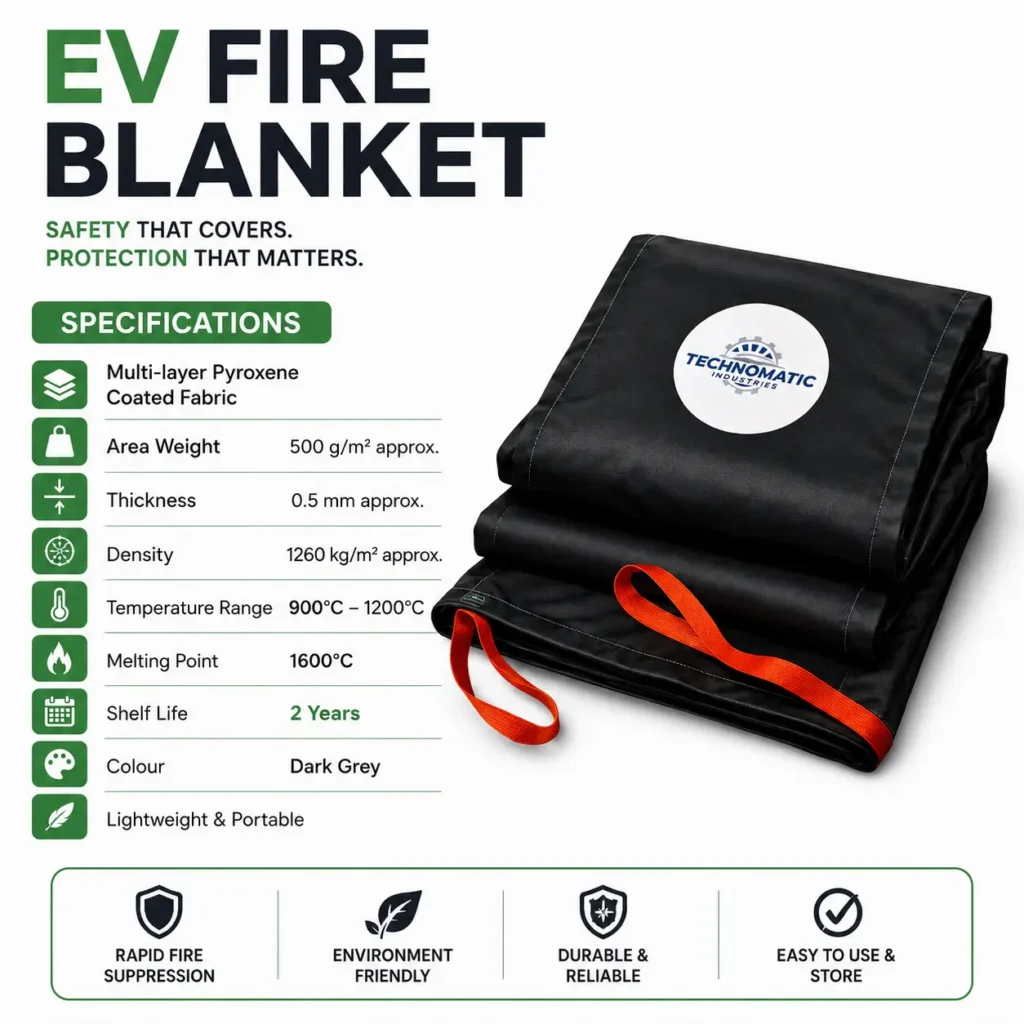
An EV fire blanket, sometimes called an EV car fire blanket or an electric car fire blanket, is a very large sheet of heat-resistant fabric that is pulled over a burning vehicle. Most are made of glass fiber or silica cloth with a protective coating, and they are built to survive far higher temperatures than the small blanket in your kitchen.
The idea is simple. Cover the car, cut down the oxygen reaching the flames, and keep heat, smoke and sparks from spreading to whatever is nearby. It is mostly about containment. The goal is to give the fire brigade time and space, not to replace them.
Why Electric Car Fires Feel Different
A petrol car fire is frightening, but fire crews know how to deal with it. A battery fire is a different problem.
Inside a lithium-ion battery pack are hundreds or thousands of individual cells. If one is damaged, overheated or faulty, it can start heating the cells beside it, and that can spread through the pack. This is called thermal runaway. Once it starts, the fire can keep itself going, and it can be very hard to stop.
Three things make this a headache for people on the ground. The fire can last a long time. It can flare up again after it looks finished, sometimes hours later and sometimes after the car has been moved. And putting it out can take a lot of water, which is not easy to find in a basement or a narrow lane.
One point deserves to be said clearly. Electric vehicles do not catch fire more often than petrol or diesel cars, based on research from several countries. They are simply harder to handle when it happens, and that is why products like the fire blanket have appeared.
What People Are Really Worried About
If you search for “fire blanket for electric cars”, you probably have one of a few concerns behind the query.
Some people want to know if it actually works. Others want to know if they can use it themselves, or what size to buy, or why prices range from very cheap to very expensive. Many are worried about a specific place, such as the basement parking in their apartment society, a charging bay at a workshop, or the garage at home. And some are just trying to figure out if a product they’ve seen online is genuine.
So, Does an EV Fire Blanket Work?
A good blanket does a few things well. It cuts down the flames and radiant heat, which protects nearby cars and the building around them. It keeps smoke and flying debris in check. And it gives firefighters a calmer fire to work on. In tight spaces like parking decks, that alone can matter a lot.
What it doesn’t do is switch off the battery. Thermal runaway can continue under the cover, so the car can still produce heat and gas, and it can still reignite. A blanket also depends entirely on how fast and how safely someone can put it in place. Fire services around the world still disagree about how much to rely on blankets, which tells you this is a useful layer, not a complete solution.
My advice is simple: treat it as one part of a plan, never as the plan.
Should You Use One Yourself?
This is where I’d be careful. A burning EV can give off toxic smoke, throw out hot debris and in rare cases vent violently. Walking up to it with a heavy blanket is not a casual job.
If a vehicle is on fire, get people away first, then call the fire brigade (101 or 112 in India). Blankets are best used by trained staff with protective gear, ideally two people working together, when the situation is safe enough to approach. If there is any doubt, stay back. No blanket is worth an injury.
For businesses, this means the blanket is only half the purchase. The other half is training your team before an emergency, not during one.
Who Actually Benefits From an EV Fire Blanket?
The strongest case is for places where fire can spread or where help takes time to arrive.
Parking operators, malls, offices and apartment societies with basement or multi-level parking come first, because a fire in a tight underground space is a serious risk. Workshops and service centres that handle EVs and hybrids are next. Then come charging stations, electric fleet operators, tow and recovery crews, and of course fire departments.
For a homeowner with a garage, a blanket can be a reasonable extra, but the basics matter far more: smoke alarms, a good-quality charger, safe wiring and a clear plan to leave the building and call for help.
In India, there is one more point worth considering. A large share of electric vehicles here are scooters and bikes, and a lot of those are charged indoors, in hallways and shops. A standard car-size blanket may be too big and awkward for that, so ask about smaller sizes if two-wheelers are your main concern.
Choosing the Right Size
Car-size EV fire blankets are usually several metres on each side, and a size around 6 by 8 metres is common. Larger vehicles such as SUVs, vans and electric buses need bigger or custom blankets.
The simple rule is to measure the biggest vehicle you expect to deal with and make sure the blanket can cover it fully and reach the ground on all sides. A blanket that leaves the wheels and underside exposed does far less. Also think about weight, because if two people can’t handle it quickly, size doesn’t help.
What to Check Before You Buy
The market is full of products that look similar but perform very differently, so a bit of homework pays off.
Start with temperature. Ask for the maximum rated temperature and how long the blanket can withstand it. A battery fire burns much hotter than the fires ordinary blankets are made for, so a general-purpose blanket is not a safe substitute.
Then look at the material and coating, and ask what tests or certifications the product has passed. Vague claims like “high quality” or “industrial grade” tell you nothing. Ask for a test report.
Check how it is packed. A bag or cabinet that opens quickly can save precious time. Find out if the blanket is reusable or single-use, and what you are supposed to do with it afterwards. Finally, think about the supplier. You want someone who answers questions, offers training and is still around when you need support.
And if the price looks far lower than everything else, be suspicious. That is usually where the corners were cut.
What Does an EV Fire Blanket Cost?
There is no single answer, and anyone who gives you one number without asking about size and rating is guessing. Price depends on size, thickness, temperature rating, testing, packaging, and whether it is reusable. Fire-service-grade products cost much more than light blankets sold for general use.
A better way to think about it is value. Compare the cost with what the blanket is supposed to protect, such as a row of parked cars, a workshop or a building. For a hobby user with one car, it is a personal decision. For a parking operator or a service centre, it is closer to a business insurance item.
Don’t Rely on the Blanket Alone
Whatever you buy, the safest setups combine several things. Use certified chargers and properly rated wiring. Don’t charge a battery or vehicle that is visibly damaged. Keep charging areas clear of anything flammable and install smoke or heat detectors nearby. Keep exits clear, post emergency numbers, and run a short drill with your team. And follow the vehicle manufacturer’s safety advice, which varies by model.
Frequently Asked Questions
1. What is an EV fire blanket?
A large, high-temperature-resistant cover that is placed over a burning electric vehicle to limit oxygen, contain heat and smoke, and slow the spread of fire until the fire brigade takes over.
2. Does an EV fire blanket put out a battery fire?
It can suppress and contain it, but it may not stop thermal runaway inside the battery. The vehicle can stay hot and can reignite, so professional help is still needed.
3. Can I use an electric car fire blanket by myself?
It is not recommended unless you are trained and it is safe to approach. In most cases, move away and call 101 or 112.
4. Is a normal fire blanket enough for an electric car?
No. Household blankets are too small and not rated for battery-fire temperatures.
5. What size EV fire blanket do I need?
One that covers your largest vehicle fully and reaches the ground on all sides. Car-size blankets are commonly around 6 by 8 metres, and larger vehicles need bigger ones.
6. Are EV fire blankets reusable?
Some are and some are not. Check the manufacturer’s guidance and the blanket’s condition after any use.
7. Are EVs more likely to catch fire than petrol cars?
Research from several countries suggests they are not, although their fires can be harder to handle.
8. Where should I keep an EV fire blanket?
Somewhere visible and easy to reach, but not so close to the charging point that you can’t get to it in a fire. Make sure your staff know where it is.
Conclusion
An EV fire blanket won’t solve every problem, and anyone who tells you it will is selling something. But in the right setting, with trained people and a proper plan, it can slow a fire down and keep a bad situation from getting much worse.
Buy on specifications, not on price. Choose the right size. And pair it with good charging habits and a clear emergency plan.
Planning safety equipment for your garage, workshop or parking facility? Talk to Technomatic Industries on +91 9313135555 or visit www.technomaticindustries.com.